Galaxiga: Galaxy Arcade Game
- 4.7
- Rating
- 100.00M
- Installs
- Free
- Price

 Analysis by App-foxy
Galaxiga: Galaxy Arcade Game is the kind of mobile shooter I open when I want quick action without learning a complicated control system. It places me behind a small spacecraft, sends waves of enemies across the screen, and asks me to survive by moving, firing, and choosing the right moment to use upgrades. It is a free arcade game from 1SOFT, available for players aged Everyone 10+.
After spending time with it, my impression is clear: this is built for people who enjoy the rhythm of classic space shooters but want the convenience of playing on a phone. It is easy to understand in seconds, yet it can become surprisingly demanding once enemy patterns, stronger opponents, and upgrade decisions begin to matter. I would recommend it to someone who likes short sessions, repeat attempts, and gradual improvement more than a deep story or a slow, realistic space simulation.
How the current version feels to play
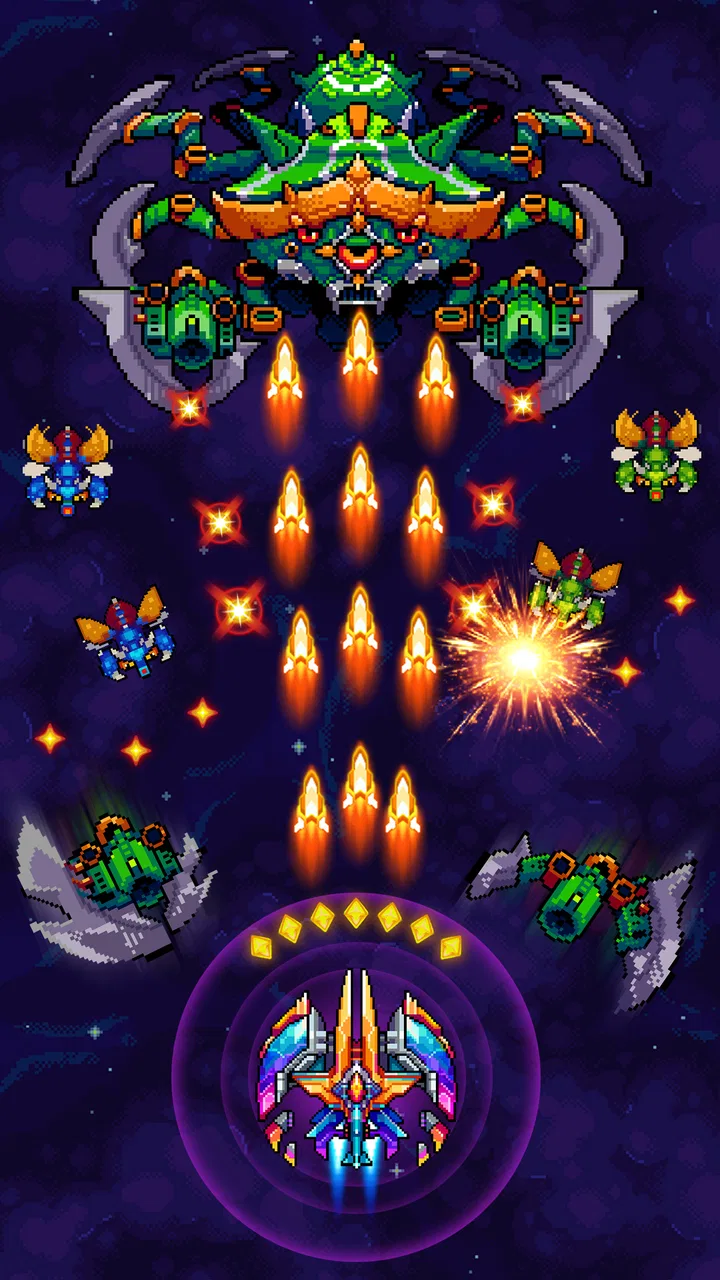
The central appeal is immediate. I do not need to study a long tutorial or memorize a large set of commands before getting into a battle. The ship moves around the lower part of the screen while automatic shooting keeps the action moving. My attention goes toward positioning: avoiding incoming attacks, lining up shots, and staying calm when the screen becomes crowded.
You May Also Like

 Blood Strike: 2.5 Anniversary
Blood Strike’s Loadouts Turn Every Drop Into a Tactical Gamble
A close look at Blood Strike’s custom loadouts: how fast access to signature weapons reshapes its battle royale rhythm, rewards preparation, and narrows the gap between fights.

 Pandora - Music & Podcasts
Pandora’s Music Is Easy to Start, but Harder to Recover
Pandora’s strength is its low-effort path from a seed to a station. Its weak spot is how much confidence it asks you to place in connection, setup, and quiet recovery.

 8 Ball Pool
 Is Built on Rivalries, Rematches, and Routine
A close look at the rivalries, rematches, shared routines, and unanswered safety questions that turn a quick pool match into a persistent mobile community.

 Samsung Music
’s Quiet Strength Is Playing What You Already Own
Its reach comes less from spectacle than from dependable access to a personal library. That simplicity is both the app’s strongest retention engine and its ceiling.

 AccuWeather: Weather Radar
AccuWeather Review: A Quick, Clear Forecast for Everyday Decisions
For everyday plans, the best forecast is the one you can understand quickly. AccuWeather makes rain timing, radar, and local conditions easy to act on, with a few trade-offs.

 Hill Climb Racing
Why Hill Climb Racing Still Turns Crashes Into One More Run
A tiny car, a bumpy hill and one more upgrade: Hill Climb Racing keeps resurfacing because its simple chaos makes every near-miss feel personal.
More From Our News Desk



That design makes the game particularly suitable for short breaks. A typical session can fit into a commute, a waiting room, or a few minutes before bed. I can play with full concentration when I want a challenge, but I can also complete a quick attempt without feeling that I have committed to a long campaign. The trade-off is that the experience is repetitive by nature. If you need a constantly changing adventure, Galaxiga may feel narrow after the initial novelty fades.
The presentation leans into familiar arcade science-fiction imagery: a lone ship, hostile formations, bright projectiles, and boss-style confrontations. I like that it does not pretend to be something else. Its pleasure comes from movement and timing rather than dialogue or elaborate world-building. The visual language is easy to read, which matters on a small screen where confusing effects can make an arcade shooter frustrating.
One useful habit is to treat the lower edge of the screen as a safety zone rather than a place to remain permanently. Staying too low can make it harder to react when attacks arrive from several directions, while moving too aggressively can put the ship directly into danger. I found better results by making small, deliberate adjustments and leaving a clear route for the next dodge. That sounds simple, but it is the difference between reacting and panicking.
Progression that gives repeated attempts a purpose
Galaxiga is not only about surviving one stage and closing the app. The broader loop encourages me to return, improve the ship, and try again when a later encounter exposes a weakness. That structure works well for mobile play because even a failed run can provide useful information. I may learn that my damage is inadequate, that I am relying too much on one side of the screen, or that I am spending resources without considering the next challenge.
The smartest way to approach upgrades is to connect them to a problem rather than buying whatever becomes available first. If ordinary enemies are manageable but a boss takes too long, offensive improvement may be more valuable. If I am losing through small mistakes, a defensive improvement can have a greater effect than a modest increase in firepower. This makes progression feel more personal: the same upgrade choice will not suit every player or every stage.
I also recommend avoiding the temptation to measure progress only by how far one attempt reaches. Arcade games reward pattern recognition, and a failed run can still make the next one easier. Watching how an enemy formation enters, identifying where projectiles tend to overlap, and learning when to move are practical forms of progress. The game becomes more satisfying when I see it as a training loop instead of a simple win-or-lose test.
What has changed and what that means in practice
The game was released on Jul 15, 2019, and its current identity is best understood as an established mobile arcade title rather than a brand-new experiment. The Android requirement is 7.0 or later, so people using older devices should check compatibility before planning around it. For most players with a reasonably recent Android phone, the important question is less about novelty and more about whether this particular arcade loop still matches their taste.
Its longevity is reflected in the size of its audience: it has passed 50 million installs, with an average rating of 4.7 from around 443 thousand ratings. Those figures do not guarantee that every player will enjoy it, but they do suggest that the basic format has connected with a large number of people. I see that popularity as evidence of accessibility rather than proof of unlimited depth. The game is easy to start, which helps explain its reach, while the long-term appeal depends on how much repetition a player enjoys.
There are also around 37 thousand written reviews, a useful reminder that players engage with it beyond a single download. I would still read recent comments carefully if I were deciding whether to install it, especially if spending limits, device performance, or progression speed are important to me. A high overall score describes the broad reception, but it cannot predict how I will respond to the game’s pacing or monetization.
From a product-evolution perspective, the important point is that Galaxiga has had time to establish its formula. I would not approach it expecting a radically different genre or a story-heavy reinvention. Its continuing value comes from polishing the familiar shoot-and-dodge structure and giving returning players reasons to improve. Any future change should be judged by whether it preserves responsive arcade play rather than simply adding more screens or more rewards.
How existing players benefit from the established design
For someone who has already played it for a while, the most valuable improvement is probably not a single dramatic feature but the ability to make better decisions with experience. Once I understand the basic controls, I can focus on efficient movement, resource timing, and recognizing threats earlier. That creates a useful difference between a new player and a returning one without requiring complicated controls.
Returning players can also use short sessions more intelligently. Instead of beginning every attempt with the same strategy, I can set a small goal: survive a particular attack pattern, test one upgrade path, or reach a later encounter without taking unnecessary damage. This turns repetition into deliberate practice. It is especially helpful for people who enjoy arcade mastery but do not have time for a long uninterrupted play session.
There is a psychological advantage to this structure as well. Because the controls are straightforward, mistakes are usually easy to understand. I can often tell whether I moved too late, entered a dangerous lane, or failed to prioritize an enemy. That clarity is more rewarding than losing for a reason hidden behind complex statistics. On the other hand, players who prefer a generous experience may find the same clarity unforgiving once the difficulty rises.
A realistic everyday use case is a ten-minute break during a busy day. I can play a few stages, stop without needing to remember a complicated plot, and return later with the same basic objective. This is where the game fits better than many larger mobile titles. It asks for attention during play but does not demand that I build my schedule around it.
Free access, purchases, and the real trade-off
The game is free to download, but it includes in-app purchases ranging from $0.49 to $339.99 per item. That range is important for anyone deciding how to play. I can begin without paying, which lowers the barrier to entry, but the presence of optional purchases means I should set a personal spending boundary before getting invested in progression.
My advice is to spend time learning the basic loop before buying anything. Early frustration can make a purchase feel like the fastest solution, but sometimes the real issue is positioning or an upgrade choice that does not match the stage. If I still enjoy the game after several sessions and understand exactly what problem a purchase would solve, I can make a more informed decision. If I dislike repeating stages, spending money may not fix the underlying issue because the core activity remains arcade combat.
This is also where Galaxiga differs from a traditional console or offline arcade game. The free entry is convenient, but the surrounding progression can make the experience feel less self-contained. Players who want a fixed-cost game with no purchase decisions may prefer a premium alternative. Players who are comfortable trying a free title and ignoring optional spending will find the arrangement more approachable.
Parents should pay attention to the Everyone 10+ rating and to the purchase range. The rating makes it more suitable for older children than a game aimed at mature audiences, but the ability to buy items still makes device-level purchase controls sensible. I would treat that as ordinary preparation rather than a reason to dismiss the game.
Where it stands beside other arcade shooters
Compared with a very simple endless shooter, Galaxiga offers more of a sense of progression and a stronger reason to return after a failed attempt. A purely endless alternative may be better if I only want to chase a score and avoid upgrade decisions. Galaxiga is a better fit when I want my ship and my own understanding of the stages to develop over time.
Compared with a story-driven space adventure, it is much more direct. There is less emphasis on exploration, character development, or narrative surprises, but I can reach the action immediately. I would choose it over a narrative game when I have only a few minutes and want a clear mechanical challenge. I would choose the narrative game when atmosphere and discovery matter more than reflexes.
It also differs from competitive multiplayer shooters because the pressure comes mainly from the stage design and my own performance. That can be refreshing when I do not want rankings, teammates, or opponents. However, players who need social competition may find the experience less motivating. Galaxiga’s strongest competition is usually my previous attempt, not another person.
The most important comparison is with other classic space shooters. Many share the same basic ingredients, so the deciding factor is feel: how comfortable the controls are, how satisfying the progression becomes, and whether the pace keeps me interested. Galaxiga succeeds when I want a familiar arcade structure with enough advancement to make repeated play meaningful. It is not the right choice simply because it has spaceships; it needs to match my tolerance for repetition and optional purchases.
Small techniques that improve the experience
First, I try to keep the ship moving in controlled arcs instead of making constant wide sweeps. Large movements may dodge one attack while placing me in the path of another. Short adjustments preserve more options and make it easier to return to a useful firing position.
Second, I avoid focusing exclusively on the nearest enemy. A distant threat with a dangerous firing angle can matter more than an opponent directly in front of me. Clearing the screen is useful, but survival often depends on removing the enemy that limits my movement rather than the one that is easiest to hit.
Third, I use a failed stage to identify one specific correction. Trying to improve everything at once makes it difficult to know what worked. If I change only my starting position or upgrade priority, the next attempt gives me clearer feedback. This is a simple approach, but it makes the game feel less dependent on luck.
Fourth, I reserve focused play for moments when I am alert. The controls are accessible, but crowded attack patterns punish distracted play. If I am checking messages or playing while exhausted, I am more likely to mistake a visual effect for a safe opening. Short does not mean effortless; the best sessions still require attention.
Who should play it and who should skip it
I think Galaxiga is a strong match for fans of retro-inspired arcade shooting, people who like gradual improvement, and anyone who wants a game that can be played in compact sessions. It is also suitable for players who enjoy learning enemy patterns and making small strategic choices without dealing with complex menus or a large cast of characters.
I would be more cautious about recommending it to someone who needs constant novelty. The fundamental loop remains shooting, dodging, upgrading, and attempting tougher encounters. That is the point, but it can become monotonous for players who want exploration or a major change of activity every few minutes.
I would also suggest skipping it if optional purchases make free-to-play progression stressful. Even without buying, the presence of a broad purchase range may affect how some people feel about advancement. A premium arcade game would be a better match for someone who wants to pay once and remove that concern.
Finally, people using an Android device below version 7.0 should not assume the game will suit their phone. Compatibility matters before investing time in a download, and older hardware can also make any action game less comfortable if performance or screen response is poor.
What I would watch as the game continues
Because the title has been available since 2019, I would judge future development by practical improvements rather than by promises of scale. The areas that matter most to me are fair progression, readable combat, stable performance, and a good balance between free play and optional purchases. New content is welcome, but it should not make the basic shooting feel cluttered or turn every difficulty spike into a spending prompt.
I would also watch how well the game serves both newcomers and long-time players. Beginners need a clear path into the action, while experienced players need meaningful reasons to refine their technique. If one group is ignored, the game can either feel shallow at the start or repetitive later. The best direction would preserve the approachable controls while adding challenges that reward skill rather than simple persistence.
For now, my recommendation is positive but specific. Galaxiga: Galaxy Arcade Game is at its best as a focused, repeatable arcade shooter, not as a substitute for a full space adventure. I enjoy it when I want immediate action, a familiar retro mood, and a reason to try one more run. I would install it for free, play long enough to understand its progression, and decide afterward whether its repetition fits my habits. That approach lets the game show its strengths without asking me to commit money or time before I know whether the loop is right for me.
In the crowded mobile arcade category, its biggest strength is the clean connection between movement, survival, and improvement. Its biggest weakness is the same simplicity: once the pattern stops being satisfying, there is not much else to distract me. With that expectation in mind, I can recommend it confidently to the right player. It is a practical pick for quick space battles, especially for anyone who still enjoys the feeling of learning a stage one attempt at a time.
FAQs for Galaxiga: Galaxy Arcade Game
01What is Galaxiga: Galaxy Arcade Game?
Galaxiga: Galaxy Arcade Game is a retro-inspired space shooter that combines classic arcade gameplay with modern graphics and controls. Players navigate through waves of alien enemies, collecting power-ups and upgrading their ships to defeat increasingly challenging bosses. It's available on both Android and iOS platforms.
02Is Galaxiga free to play?
Yes, Galaxiga is free to download and play on both Android and iOS devices. However, the game includes in-app purchases that allow players to buy additional lives, power-ups, and other enhancements to improve their gameplay experience. These purchases are optional and not necessary to enjoy the game.
03What are the main features of Galaxiga?
Galaxiga offers a variety of features, including multiple levels with increasing difficulty, a wide array of ships and weapons to choose from, and engaging boss battles. The game also supports online leaderboards, allowing players to compete with others globally. Its vibrant graphics and smooth controls make it a standout in the arcade shooter genre.
04Can I play Galaxiga offline?
Yes, Galaxiga can be played offline, allowing you to enjoy the game without an internet connection. However, certain features like leaderboards and social sharing require a connection. Playing offline is ideal for uninterrupted gameplay, especially in areas with limited connectivity.
05What devices are compatible with Galaxiga?
Galaxiga is compatible with most modern Android and iOS devices. It requires Android version 4.4 or higher and iOS version 9.0 or later. The game is optimized for both smartphones and tablets, ensuring a seamless gaming experience across different screen sizes.
Pros
- Engaging retro-style graphics and sound.
- Smooth gameplay with responsive controls.
- Variety of challenging levels and bosses.
- Frequent updates with new content.
- Offline play available for on-the-go gaming.
Cons
- In-app purchases can be pricey.
- Ads can interrupt gameplay.
- Limited customization options.
- Repetitive gameplay can occur.
- Some levels feel overly difficult.

Galaxiga: Galaxy Arcade Game
Gallery